
When I was a school leader, there was one sentence that could stop me in my tracks: “I don’t feel safe.”
If someone hit me with that sentence, I would feel immediately stuck.
I’d be having a tough conversation with someone, and they’d say, “I don’t feel safe.” I’d ask a teacher to handle a classroom challenge that didn’t involve anything physical. “I don’t feel safe.”
We hear similar sentiments from leaders every day in our programming. They want to challenge their staff to meet standards, but when they’re met with this specific pushback, they don’t know where to go next.
There are a lot of misconceptions about psychological safety, what it is and what it isn’t. To be fair to my teachers in the aforementioned scenarios, when the rules of engagement aren’t clear, everything that is uncomfortable legitimately does feel unsafe. Our caveman brain doesn’t know the difference between a hard conversation and being attacked by a lion.
In a recent EdEx session, our adjunct faculty member, Jessica Cunningham Akoto, shared an article that set off lightbulbs for every leader in the room: “What People Get Wrong About Psychological Safety.” The core argument: psychological safety is not protection from discomfort. Psychological safety is an environment where people feel safe to speak up. Psychological safety is about candor. Not comfort. Simple to state. Hard to operationalize.
First step? Knowing what psychological safety is and what it isn’t.
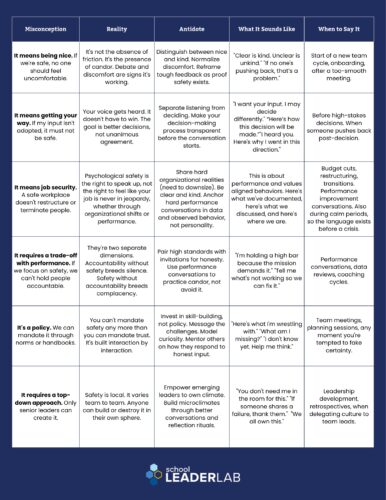
The table below names six of the most common misconceptions cited in the article, what’s actually true, and what to do about it.
Getting the definition right matters. And so does this.
Sometimes, there is real harm in the workplace. Sometimes speaking up does come with retaliation. That is a problem and a lived reality for many people. That’s why operationalizing candor and getting clear about what psychological safety is and is not is not a nice-to-have. It’s imperative.
As a Black woman, I have always appreciated leaders who proactively name the rules of engagement. Who tell me that speaking up is welcomed and expected. Without that, I’ll default to the valid assumption that if my ideas go against the grain, I will be penalized differently than my peers. That assumption isn’t a misconception. It’s informed by real experiences. The leader’s job is to make the stakes explicit, not leave people to interpret hidden rules on their own. And the best leaders have also made it clear that just because I have an idea or offer pushback does not mean it will be taken. That’s disappointment. That’s discomfort. It’s not a lack of safety.
Psychological safety doesn’t become real in the abstract. In fact, invoking the term without defining it makes things worse. It becomes real when leaders operationalize the values and aligned behaviors that create a psychologically safe environment. Only 23% of U.S. employees strongly agree they can apply their organization’s values to their work every day. Psychological safety is no exception. The strongest values come with behaviors attached, ones that tell people how to show up on a Tuesday, not just what we abstractly aspire to. And even if you haven’t named psychological safety as a value, the term is in the popular lexicon across all organizations, not just education. Your staff will want to know where you stand.
Here’s what to do now.
Define psychological safety early. Don’t have this conversation with your staff right now. Mid-year, it will feel retaliatory, like a response to a specific person or moment rather than a shared commitment. As you plan for summer PD, leave room to define what psychological safety looks like at your school or on your team. Don’t wait for the Executive Director or Superintendent to address it first. Start with what’s within your locus of control: your school, your leadership team, your grade level. Just start.
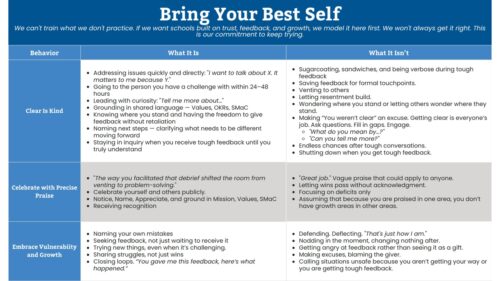
Connect your values to observable behaviors. For every value, name what it looks like when the team is living it and what it looks like when they’re not. That gap between aspiration and action is where confusion lives and where safety quietly erodes. Check out how we do this at School Leader Lab below.
Check yourself. If you react negatively when staff speak up, that will legitimately be perceived as a lack of psychological safety or an inability to speak with candor. If people get sidelined for having opposing views or experience consequences for expressing misalignment, that’s something to watch. Naming upfront how decisions will be made and why you went in a direction others didn’t prefer is a powerful antidote. So is breathing.
Revisit the definitions every year. Teams change. Dynamics change. You change. The shared understanding you built in August may not transfer to a new hire or survive year over year. Keep coming back to this conversation. Psychological safety is an experience, not a destination.
Clarity around what psychological safety is and is not on your team lets you and others hold a high bar with honesty and care. That’s what keeps your best people. That’s what our kids deserve. And it gets us a little less stuck.